What “It doesn’t go anywhere” really means

10 Jan

In an outtake from his recently published book, Human Transit’s Jarrett Walker discusses a list of seven criteria that he says transit has to address to effectively compete with driving:

1.    “It takes me where I want to go.”

2.    “It takes me when I want to go.”

3.    “It’s a good use of my time.”

4.    “It’s a good use of my money.”

5.    “It respects me.”

6.    “I can trust it.”

7.    “It gives me freedom to change my plans.”

While no mode of transportation meets all seven demands perfectly, Walker says, “[t]he dominant mode in a community is the one that best addresses the seven demands, compared to the available alternatives, in the perception of the majority of people.”

That observation goes a long way toward explaining why so many people who live well within MARTA’s service area still drive most of the time if they have that choice. Walker’s list unpacks what they mean when they say MARTA “doesn’t go anywhere.” It’s not that people are looking for reasons not to use transit, but rather that they so often have more reasons to drive. In relatively low density areas, he says, “the automobile meets all seven demands handsomely.”

He also pulls apart the multiple meanings tangled up in the word “convenient” here.

Sometimes it pays to walk. Literally.

28 Dec

Found fiveIt would have been warmer to catch the 110 bus from Trader Joe’s to Buckhead Station last night. But then this $5 bill might still be lying in that flower-less flower bed next to the sidewalk.

Not quite as cool as spotting a $20 bill swirling around in a little pile of windblown leaves at the top of an escalator at Civic Center Station about a year ago, but still worth that 15 minutes in the wintry wind.

Weekend Workarounds: MARTA on NYE

28 Dec
Fireworks

Photo by jeff_golden on Flickr

If your Saturday afternoon plans involve a trip on the route 1, 16, 32, 110 or 186 bus, check out the re-routes (PDF) that are planned for 12:30 p.m. to 3:00 p.m. that day. The Chic-Fil-A Bowl parade will be borrowing parts of Peachtree Street, Andrew Young International Boulevard and Marietta Street during those times.

Street closures for the Peach Drop at Underground start at 4:00 p.m. Saturday afternoon. That means service on routes 1, 3, 13, 16, 32, 42, 49, 51, 55, 74, 110, 155 and 186 will be diverted (PDF) from downtown to other stations from 4:00 p.m. until the end of service that night.

The good news is that if you somehow manage to get where you’re going despite all the celebratory circumventions, rail service will be extended that night, with the last trains in all directions departing Five Points Station at 2:00 a.m. Sunday.

More info at MARTA’s site.

They’re not kidding

21 Dec

Flat tire at Exit 87

You really should walk around your Zipcar to check that nothing’s wrong with it before driving away. Otherwise you too could end up sitting just short of Exit 87 with a flat tire and hoping that none of the vehicles passing by about 36 inches away are being driven by someone who’s also texting, shaving or eating a bowl of soup.

Complaint Desk: Almost, but not quite

14 Dec

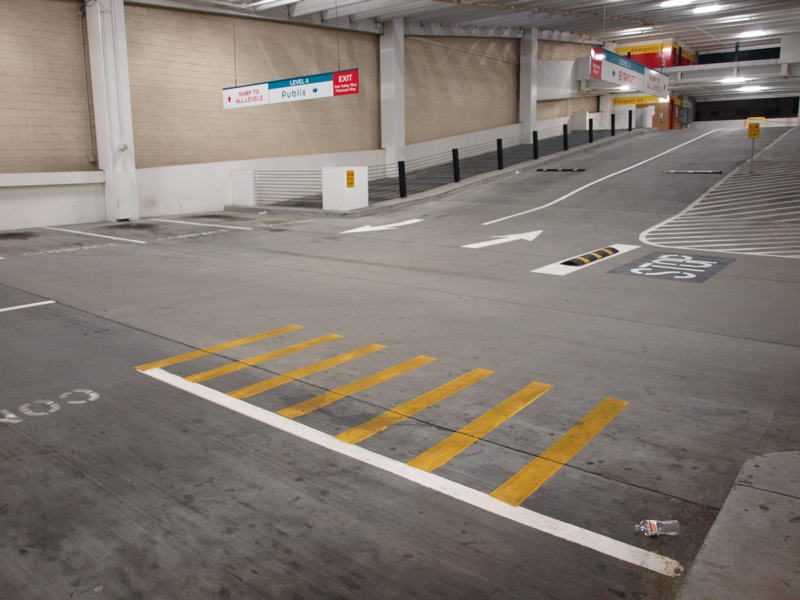
Adequate, designated pedestrian areas in parking decks are pretty rare. When crosswalks or paths are provided, they sometimes look as if the designer had only a vague idea what they’re used for.

An example:

One entrance to this Buckhead shopping center has good pedestrian access. Unfortunately it’s neither of the two most likely to be used by people who walk there. Those two entrances lead through the parking deck and feature a crosswalk that runs into columns twice, then vanishes just when it reaches two opposing lanes of traffic. Having it continue toward the store, however, would have required eliminating a few parking spaces close to the door. It’s probably not easy to get something like that past developers who expect that most people will drive to their project. But even people who do drive there have to walk to make it to the stores.

Crosswalk, facing westCrosswalk looking east

Near the truncated crosswalk is what appears to be a sidewalk leading to Target’s entrance. It’s in fact just a curb barely wide enough for one person. But even that single person has to step off and out into the the traffic to edge around more columns.

Not a sidewalkCurb width

All this has to be done while watching out for cars driven by people talking on the phone and trying to swoop into the nearest vacant parking space. If that’s not enough of an adventure, there’s always doing it again on the way out to look forward to.

Scott on cuts and capacity, Flowers leaves TIA campaign, and TIGGER funds power Laredo

4 Dec

It’s difficult to remember the last time MARTA was adding rather than subtracting service. For years now, bus coverage has been attenuated and train headways have crept into the double digits, all in an effort to address budget shortfalls. But in an interview concerning the agency’s ongoing three-phase audit, MARTA’s general manager Beverly Scott described just how badly attempts at “cutting our way” back into the black have undermined the system’s functionality:

“We are operating at less than 30 percent of our capacity,” she said. “We have the ability to run our trains every 90 seconds (at peak times, MARTA trains run about every eight minutes). We need to have travel times that are competitive.”

  • Also from The Saporta Report:

Another member of the regional team charged with generating voter support for next summer’s transportation sales tax referendum has disembarked. Communications Manager Liz Flowers resigned in mid-November. Glenn Totten, former lead consultant for the campaign, resigned in August.

  • Another MARTA tidbit:

MARTA’s Laredo bus maintenance facility is now the site of what the agency says is “is the largest solar canopy in Georgia and the second largest structure of its kind at a United States transit system.”  The structure was built with $10.8 million in federal TIGGER grant funding awarded in 2009.  It provides cover for 220 bus parking stalls, which are lit by solar-powered LEDs. Laredo operates 24 hours a day and the new canopy’s photovoltaic cells are producing “enough electricity to offset a significant portion of this facility’s annual electricity consumption,” MARTA said in a press release.

Officials at Laredo bus facility ribbon cutting

Officials and technology company representatives attend the Laredo facility's solar canopy ribbon-cutting. Photo courtesy of MARTA

In addition to reducing electricity consumption and producing light for nighttime work,  the canopy will provide shade during the day. It’s expected to reduce the temperature underneath it by “between 20 and 30 degrees” during the summer, decreasing the need for air conditioning and fuel use by idling buses.

See the photo at Metro Magazine for a better idea of the canopy’s size.

Idea of the Day: Brasilia Syndrome

28 Nov

Meet Danish architect and urban designer Jan Gehl. If you have about 30 minutes, he can explain why the parts of a city that look so appealing on the approach from an expressway are often so boring to be in. He calls it the Brasilia Syndrome. If you don’t have that long, it works something like this:

Around 1960, Gehl says, architects and planners began designing streets and developments as compositions of landmark buildings, or with an eye toward how they could best accommodate the movement of cars. Other uses were given little consideration, if any.

Density was moved from horizontal to vertical as free-standing towers replaced smaller buildings  placed close together. Buildings were pushed back from the street. Banks, food courts, dry cleaners and post offices were added inside so that people could go the entire day without ever being in the surrounding neighborhood.

Planning cities “to make cars happy,” as Gehl describes it, resulted in a landscape meant to be viewed at about 40 miles per hour (think of an office park or strip mall – large signs, little detail, buildings seen best from a distance) instead of a pedestrian’s pace of around 3 miles per hour.

In extreme cases this type of planning produced the “helicopter urbanism” of cities planned entirely from the air, like Brasilia, or more recently, Dubai.

Continue reading

New URL

21 Nov

The OO has moved to: Oppidanomnibus.com

Underground, Urbanophile and Waffle House

20 Nov

This slideshow requires JavaScript.

Here are a few photos from last week’s Unseen Underground walking tour, led by Jeff Morrison.With the weather mostly remaining pretty warm, there might still be a couple more this year. See the tour’s Facebook page for contact info.

The tour is in pretty constant motion, and when it’s not moving there’s a lot of information to take in, so it doesn’t lend itself to thorough photo-documentation. Just getting these few shots required some scurrying to catch up afterward.

Also:

  • The Urbanophile re-ran “Is it game over for Atlanta?” today. The post was originally written before the release of census results that showed that the city’s population numbers had essentially remained flat for 10 years. At that time, estimates suggested that population had increased by 28 percent. But, Aaron Renn wrote that “converging trends point to a possible plateauing of Atlanta’s remarkable rise, and the end of its great growth phase.”
  • From What Now, Atlanta? – The site of a former souvenir shop at the corner of Andrew Young International Boulevard (a name nearly longer than the street is) and Centennial Olympic Park Drive will become the third and largest downtown location for Waffle House.

Did you know…

15 Nov
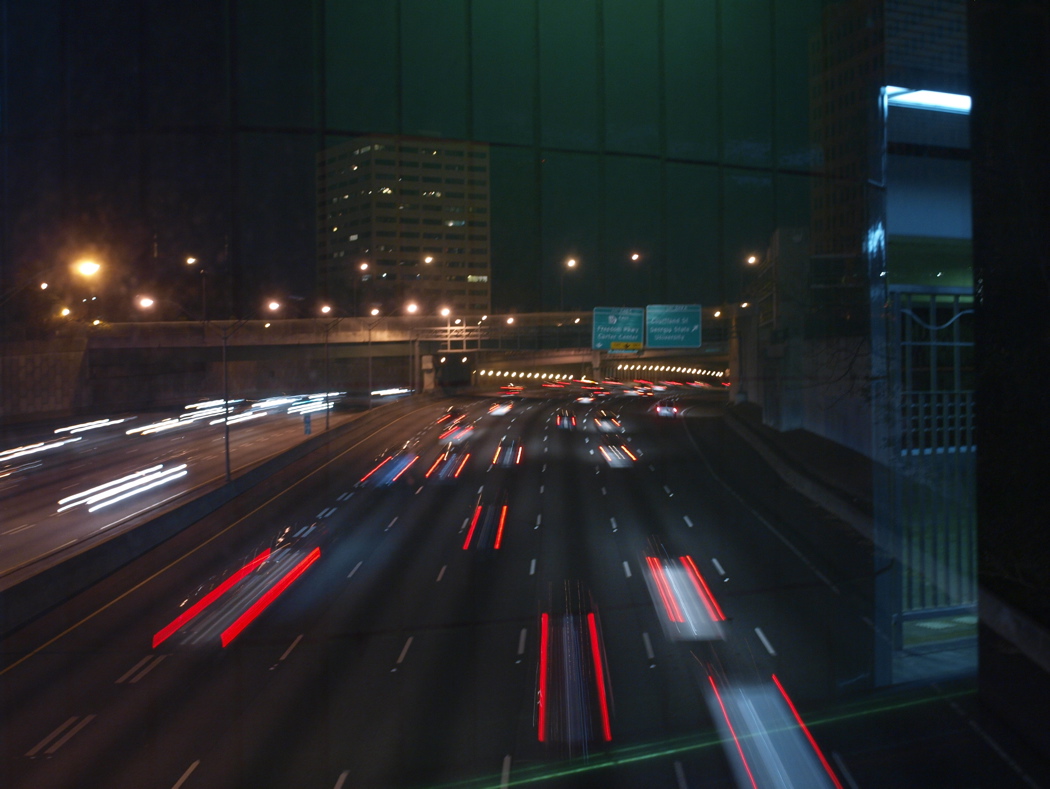
Southbound traffic on I75/85 passes under Civic Center Station

A window at Civic Center Station looks out onto the traffic passing underneath the station platform. The reflection in the center of the photo is one of the station's white-tiled columns.

that Civic Center Station is the only subway station in the world suspended over a highway?