Did you know…

8 Mar

That there’s a produce market downtown and that it’s been there for almost 20 years? 

The State of Georgia office building at 2 Peachtree Street, with its gates, revolving doors and empty street-level retail spaces, doesn’t look particularly inviting at ground level. Everything about it seems to say “keep going” rather than “come in.” It certainly doesn’t give the impression that one could walk in with $10 and leave with three apples, three oranges, a pound of strawberries, some freshly roasted cashews, a slice of cheesecake and a couple of dollars change. 
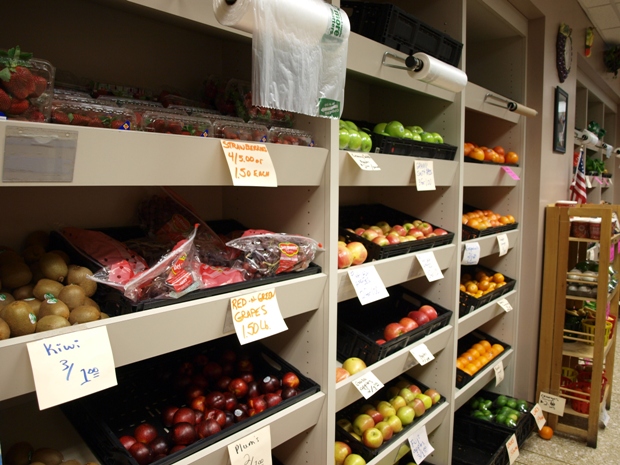


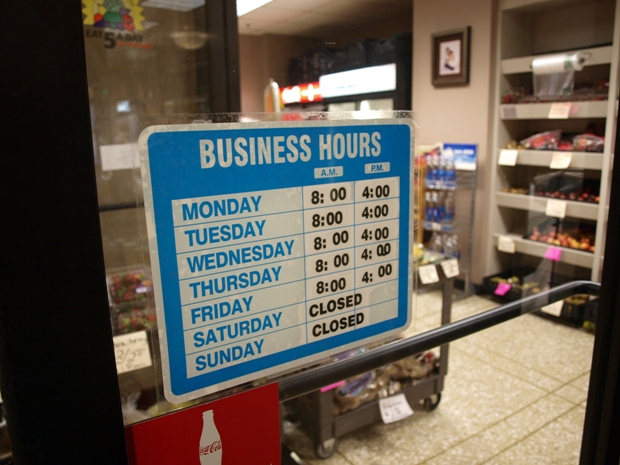
There’s no sign for R & R Produce on either the Marietta or Peachtree Street side of the building. The store is about as deep as a large office cubicle and it takes only around 15 steps to walk the length of it. But the sliver of ground floor space is jammed with fruits and vegetables, most of them from the Forest Park Farmers Market.

 

The owners greet some of the shoppers by name, but even speak to those they’ve just met as if they’re long-separated friends. Office workers, students and people struggling to wrangle small, antsy children stand patiently in the single line to pay (cash or EBT only). As they wait, the shoppers marvel at the variety of foods and remark on the low prices. Usually at least one person says “I had no idea this place was here.”
 

Lingering Effects

5 Mar
loitering is good

Photo by Flickr user nitrodog

Among the many and varied complaints about urban life in Atlanta, one rarely hears “There aren’t enough people just hanging around.” It’s much more common to hear the opposite (see any discussion of Atlantic Station or Five Points). But places where people of all ages and backgrounds can just spend time during almost any part of the day – without being expected to buy something or pay admission – have long been known by urban planners as vital to successful cities.

Emily Badger at The Atlantic Cities reflects on how being out on the street, especially at night, became something that people in most American cities just don’t do.

“We went to great lengths to discourage the wrong people from hanging around, but this of course discouraged everyone else as well.”

Increased suburbanization and car ownership in American cities during the last 50 years have also meant increased privatization of leisure activities. For people who can afford them, home theaters, gym memberships, backyard playground equipment, indoor malls and chain coffee shops now replace the city centers, public parks and plazas that used to serve as community living rooms. People with other choices for places to spend their time drifted away from the streets. People without those choices stayed. Soon almost the only people hanging around on the street were people with nowhere else to go, leaving the impression that the streets were no place for “regular” people. At that point, Badger says, what would have once been called “lingering,” became “loitering.”

Laws and design standards meant to combat loitering led to the creation of even more uninviting, and thus emptier, streets. People like places where there are other people. Therefore, nobody goes where nobody goes.

Some cities are successfully throwing that trend into reverse with projects like Chicago’s Millennium Park and New York’s High Line. Less wealthy cities will have to get more creative, Badger says, by carving out smaller, cheaper “oases” of public space for lingering. Until then, the streets will remain places where the police keep trying to chase the “wrong” people away, while everyone else stays home.

The Things You See…

1 Mar

…on the floor of the #16 bus

This slideshow requires JavaScript.

Idea of the Day: Pre-walking

28 Feb

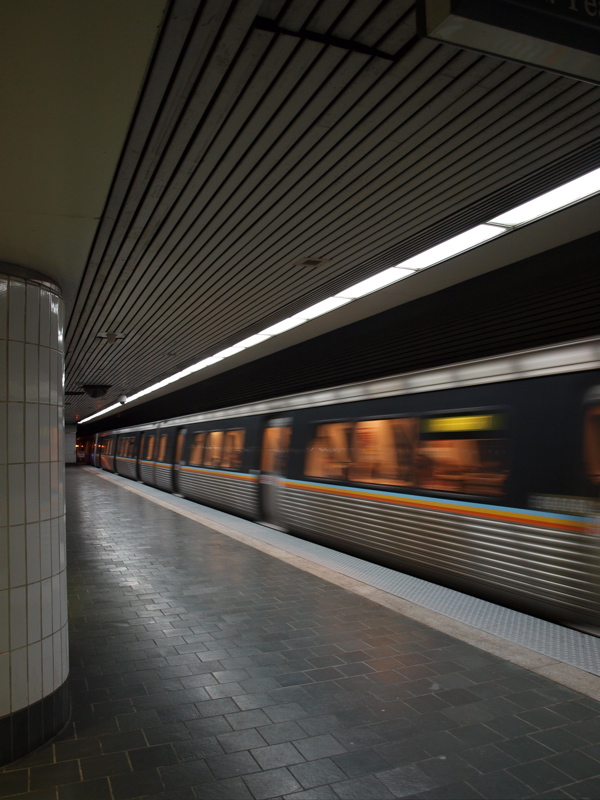
For all of its advantages, transit doesn’t offer much in the way of shortcuts. A missed train is a missed train and there’s no shortening the time that you’ll spend watching the arrival board cycle through the Zipcar and Picadilly ads until the next one pulls in. But after taking the same trains at the same stations for a while,  some riders develop a menu of minute-shaving strategies known as pre-walking.


Pre-walking involves standing at a certain place on the platform in order to board a specific car through a specific door when the train arrives. The chosen boarding point is usually one that puts the rider as close as possible to a preferred exit at the destination. These strategies aren’t always about finding the exit closest to the street or building you want. Sometimes it’s faster to go out of  your way so fewer people are in your way.


Some examples:

  • The last door of the last car on a southbound train puts you closest to the less-crowded escalator at the north end of the platform (or maybe it just seems less crowded when you’re the first person to get to it) when arriving at Five Points.
  •  The last door of the last car on a North Springs train puts you right at the exit at the south end of the platform at Buckhead Station – especially important since it’s still the only exit. Also, if you’re running late for the 110 bus, not having to walk the entire length of the station to get out can easily make the difference between catching it and either having to wait for the next one or walk to your destination.
  • The back of the first car or the front of the last car on a train in either direction is closest to to an exit at Civic Center Station.
  • The middle or last door of the last car of a Indian Creek train puts you right at the stairs on the west end of the platform at Inman Park-Reynoldstown Station. Oddly, that set of stairs is much less popular than the set at the east end of the platform, which is farther away from the exit.

To read about it, you might get the idea that pre-walking is some esoteric, expert-level transit users’ skill. Phrases like “super-secret” and “something only New Yorkers know” crop up a lot.  A bit of impatience or a tendency toward tardiness are really the only requirements, though. Besides, nothing’s a secret any more once there are apps and charts for it.

 H/T to The Atlantic Cities

The things you see…

23 Feb

When you’re crossing Piedmont Road.

Slow Going: Congestion stats from ARC

21 Feb

Image: ARC

The latest Atlanta Regional Commission’s “Regional Snapshot” shows how Atlanta’s traffic congestion stats stacks up against 14 other major metros. The ARC analyzed data from the American Community Survey, the American Transportation Research Institute and the Texas Transportation Institute and found Atlanta ranked:

  • 11th for total hours of congestion-related delays
  • 9th for the total number of jobs
  • 4th for the total number of hours that commuters spend traveling to their jobs each year. The Atlanta metro average was 126 hours per year, which equals about three weeks of workdays.
  • 4th for the percentage of workers who have at least a 45-minute commute to work
  • 1st in the Southeast for congestion cost per commuter. Here’s how the congestion cost was calculated

Metro Atlanta’s I-285 and 1-85 North interchange also ranked ninth among the 250 most congested bottlenecks in the country, according to American Transportation Research Institute data.

A possible upside to those numbers: “Areas with the most jobs tend to also have the most congestion,” the ARC report said. So, Atlanta’s status as a major job center is still intact, but that might soon be overshadowed by its reputation as a place to sit in traffic on the way to those jobs.

Pruitt-Igoe, “Going Solo” and going with the flow

14 Feb

There’s no direct reference during the film to a specific myth, but when it comes to public housing, there are plenty to choose from: Who lives there and why, what it’s like to live there, what the residents need, how much design matters, what the role of public housing is in cities, whether its failures are built in, whether it can ever be done right.

Something that immediately stands out in aerial photos and site models of Pruitt-Igoe is the degree of “overdimensioning”. Everything is so big and so far apart that it’s out of scale with what humans can see and interact with, which contributes to a sense of isolation, even with thousands of other people around.

  • One of the demographic trends to surface in the 2010 census was the historic increase in the number of people living alone, especially in major cities. According to census data, 44  percent of households in the city of Atlanta now consist of someone living alone. That’s well above the national rate of 28 percent, which is seven times what it was 60 years ago. Eric Klinenberg, an NYU sociologist took a look at the causes and effects of living in a country where more and more people are – by choice or circumstance – living on their own. He talked about his book “Going Solo” on last Monday’s Diane Rheme show. If you don’t have time to listen to the whole show, Klinenberg has also written for  and been written about in the New York Times in the last couple of weeks.  His opinion piece has some infographics and an interactive map for demographic and geographic comparisons of who’s living alone and where.
  • The words “traffic planning” probably bring to mind a preoccupation with quick, efficient movement of cars, but as more people move into cities, and car use in cities declines, the science of managing pedestrian traffic is becoming more important. Two Zurich-based physicists are working on models to help architects and planners predict and guide pedestrian traffic in the most crowded places.

If this happened every day…

27 Jan

No one would ever want to drive to work again. 

(Full-screen and headphones highly recommended.)

KNUCKLES | BLAKE – WHAT I LIKE from Paul Bryan on Vimeo.

MARTA News: Buses and Bridges

17 Jan

Bus stop sign

If you’re already bored with last September’s set of bus route modifications, another round is being proposed to take effect in April. MARTA will hold public meetings Tuesday, Jan. 24 and Thursday, Jan. 26 for input on the proposed changes, which will affect five routes:

  • Route 1 – Centennial Olympic Park /Coronet Way
  • Route 12Howell Mill Road / Cumberland
  • Route 32Bouldercrest / Georgia Aquarium
  • Route 86Fairington Road / McAfee Road
  • Route 115Covington Highway / South Hairston Road

Preliminary work is scheduled to get underway today on the new entrance and pedestrian bridges that will link the north end of Buckhead Station with Tower Place. MARTA awarded the contract (PDF) for construction of the project to Archer Western Contractors last October and expects construction to be completed in November 2013.

Edit: See Atlanta Business Chronicle for more, bigger and better renderings of the project. H/T to AtlUrbanist

Distance only gets you halfway there

13 Jan

Because of Atlanta’s lingering tendency toward low-density development, lots of the “cool” places that have cropped up in the last few years are in places that can be inconvenient to get to using transit. The prospect of trying a new gallery, restaurant or store loses a lot of its appeal when getting there requires an hour of walk-wait-ride-wait-ride-walk, especially when it would be a 10-minute drive from your starting point.

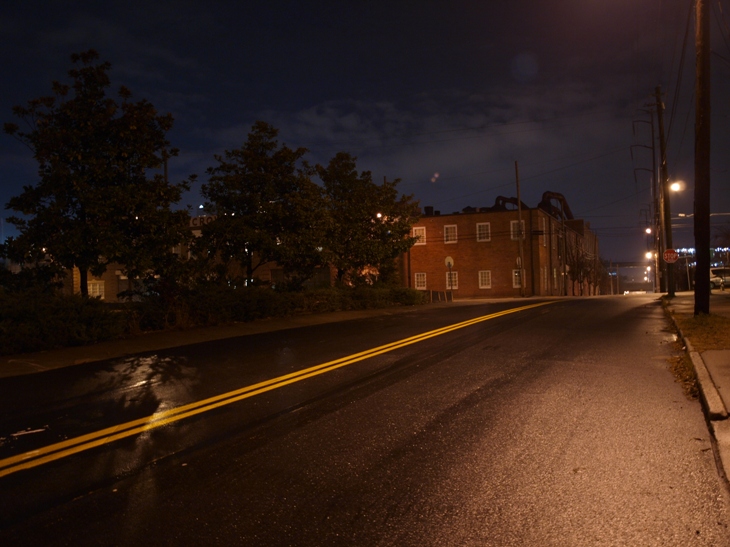
So when The Little Tart Bakeshop (LTB) opened at a Memorial Drive location less than a mile from King Memorial Station with Octane, it looked like a rare and welcome exception to that trend. In order to walk from King Memorial Station to LTB, you only have to go South on Grant Street, cross Memorial Drive, then continue walking east on Memorial Drive until you reach The Jane, which LTB is on the south side of.  Sounds simple enough. But it looks like this:


Grant Street tunnel

King Memorial Grant Street lot

There were supposed to have been a couple more photos from Memorial Drive, but the camera drew some unwanted attention there and it was starting to look like this post was going to end up being less about a bakery and more about a robbery.

These shots were taken at 6:45 p.m. in January, but even with the addition of sunlight (and subtractration of the guy sizing you up and eyeing your camera), the empty lots, narrow sidewalks, close, fast-moving cars and lack of other pedestrians make it a monotonous, un-inviting walk.

The parking lot behind The Jane was nearly full of cars, as were the lots and sidestreets near the bars and restaurants on either side of it. The lack of people on the street was no indicator of the number of people to be found at the destination. But both on the way there and on the way back, it felt as if a dead possum in the road and I were just about the only ones who tried walking anywhere that night. People are attracted to a space by other people, so if no one walks there, no one will walk there.The Little Tart Bakeshop