Well, this ought to be interesting.

8 Dec

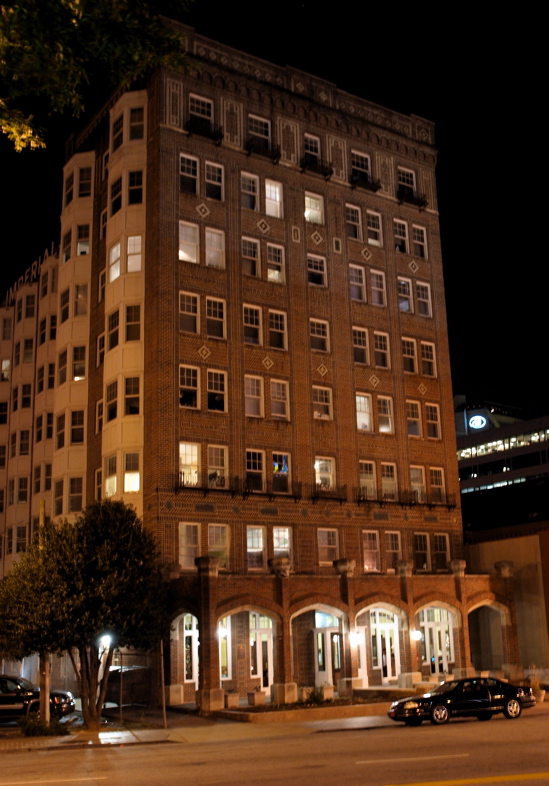
The new owners of the building now occupied by the men’s shelter at Peachtree and Pine are scheduled to have a hearing on their motion to evict the shelter from the space Thursday, according to the Midtown Ponce Security Alliance.

Thursday’s docket isn’t posted online at Fulton Superior Court’s site yet, but should be there Wednesday evening. As of right now, the hearing is scheduled for 2:30 p.m., Thursday, Dec. 9 in courtroom 5E, according to MPSA’s announcement.

Metro Atlanta Task Force for the Homeless appears to be carrying on as normal in the space, though, even opening a coffee shop on the Peachtree Street side of the building late last week.

Again, I’ll believe it when I see it. Evicting homeless people from a shelter in December is not going to play well politically. The shelter’s management isn’t likely to go quietly and  another NPR story won’t be far behind if the eviction goes forward. The wheels are turning, but it’s anyone’s guess how far they move right now.

Grand Plans, Iffy Execution

7 Dec

This slideshow requires JavaScript.

I made it to the afternoon sessions of the Grand Plans, Everyday Life symposium at Georgia Tech’s College of Architecture Saturday.

For someone completely unfamiliar with the Atlanta Beltline or who hasn’t been following its progress, it would have been a highly informative afternoon. Just about anyone else would have been contending with a raging case of Powerpoint fatigue and hoping to not hear the word “Beltline” again for a long time.

The streetcar projects, which are finally getting off the ground, warranted scarcely a mention the whole afternoon, perhaps because they’re municipal projects and the Beltline is more of a bottom-up undertaking. The streetcar is also lacking a  “face” like Ryan Gravel, who originally conceived the project, and evangelists like Angel Poventud. That’s not a complaint, just an observation.

Jennifer Clark moderates the panel discussion at Grand Plans, Everyday life. From left: Jennifer Clark, Fred Yalouris, Albert Churella, Angel Poventud, Ryan Gravel, Brian Leary

Albert Churella’s presentation – “Race, Railroads and Federalism” – just about made the trip worth it, though. Churella, who holds a doctorate in business history, is an assistant professor of social and international studies at Southern Polytechnic State University. He discussed (as thoroughly as one can in about 30 minutes) the effects of race, class and politics on transit planning in the Atlanta metro area, which is a topic that could easily be a day-long symposium of its own.

Maybe all the speakers were talked out by 6:15 p.m., when the time for the panel discussion rolled around. It was a bit lethargic, although it did briefly address concerns that the Beltline will be Atlanta’s version of a “Starbucks urbanism” project by and for upper middle-class people. That’s another topic that could easily warrant a long discussion on its own.

Strangely, the Q&A portion of the panel discussion was cut off after about three questions from the audience because of time constraints. Just from where I was sitting, I could see three more people with their hands raised to ask questions when the moderator said that they absolutely had to end. If you schedule an event in such a way that only allows for 10 minutes of questions from the people who sat there and listened all day, maybe your planning needs some work. But, the event was free, so I supposed one can only expect so much.

It was drizzling a little when I left, but I walked back to Midtown Station. It was a much quicker walk than I expected, and thanks to the many improvements to the campus and 5th Street, vastly more pleasant than it was eight years ago.

The trip to the campus is another story.  I’d planned to try the Tech Trolley, but the online weekend schedule simply says that it starts running from Midtown Station at 10:00 a.m. and runs “every 36 minutes.” Why 36? Couldn’t they just have it wait the extra four minutes to make the arrival time easier for riders to calculate? Or, better yet, actually list the times?

The long wait between Trolley runs put me off that idea, so instead I rode the #12 MARTA route for the first time. I caught the #110 about two blocks from my building, got off at Peachtree and 10th at 1:05, and scurried down to the station just barely – I thought – making it in time to catch the #12 that was scheduled to leave at 1:10. The bus was sitting there when I arrived and I got one of the few remaining seats. The driver, however, didn’t appear until at least 1:16. Is that normal?

Many’s the time I’ve sat on the #110 at Arts Center for several minutes past the scheduled departure time. I understand leaving late after arriving late, but what’s the reason for buses arriving at a station on time or early, then leaving several minutes late?

It seems like a little thing, but being kept waiting, for no reason that’s apparent, is something that riders really resent, especially those who don’t have another option to get where they’re going. It’s also one of the things that will keep choice riders off the buses forever. MARTA really can’t afford that.

France-Atlanta, Peachtree-Pine, and the Q

2 Dec

Sorry for falling off the face of the earth for so long. But, rather than bore you with the reasons, I’ll tell you about a few of the things that I should have been writing about the last couple of weeks:

  • According to the Midtown Ponce Security Alliance, the homeless men’s shelter at Peachtree and Pine won’t exist much longer in its current manifestation. MPSA doesn’t cite a source for the info, so it’s hard to tell how legitimate it is.  As with any change this big, I’ll believe it when I see it.
  • MARTA’s first BRT projects are up and running on Memorial Drive. Although they’re lacking dedicated lanes, the new “Q” route buses do have signal priority technology, queue-jump lanes at two intersections, and limited stops. I have absolutely nowhere to go on Memorial Drive, but I want to ride it just to see how quick the trip from one end of the route to the other is. Have you tried it?

Found: Human Transit

13 Nov

Human Transit is a transit planning and policy blog written by Jarrett Walker, a transit planning consultant in Sydney.

Rather than try to explain what’s so cool about HT, I’ll let the author do it:

“Much of my work has been about analyzing public transit problems to separate the technical question from the question about values.”

For all my fascination with transit, I’m not conversant with many of the technical aspects of it because I came by my interest solely through being a user. Reading HT, it’s easy to become more fluent in the language of the gears and levers that make a transit system work (well or badly).

But along with that, HT acknowledges that transit planning decisions aren’t value-neutral. When planners develop routes or schedules, or reduce or eliminate service, it’s an expression of values – values that inevitably won’t align with those of some users. That conflict – between users’ preferences and what planners see as most efficient and cost-effective – is present in every transit system, from the most modest to the most robust.

The writing at HT can feel a touch jargon-y if you’re not used to it, and it’s often not a quick read, but you’ll always come away knowing something that you didn’t before or thinking about something that you did know in a different way.

YAF exhibition at the Central Library: Come for the photos, stay for the furniture

11 Nov

This slideshow requires JavaScript.

I returned some library books on time last week, just to see what it was like. As if that wasn’t enough novelty, the exhibition of selected submissions from the Young Architects Forum‘s  “Envisioning Breuer” photography competition was in the first floor exhibit space. It’s been up since Oct. 14, but it runs until Nov. 28.

The Central Library is not an easy building to photograph, but there were a lot of really creative, surprising images there. Also surprising was the Room and Board furniture that’s been moved in, making the exhibition area it more of a “place” than just a space.

The presence of appealing, modern furniture in that space does a couple of things:

  • In addition to a placemaking function, the furniture suggests that the people who chose it care about the kind of experience that the people using it have at the library – not a feeling that’s conveyed in much of the rest of the building.
  • It makes the rest of the library appear even more shoddily furnished than it already does. Continue reading

Imperial, overstretched

10 Nov

The development company that renovated the Imperial Hotel is in pretty dire straights, which could be very bad news for the people living there.

Imperial Hotel - Peachtree at Ivan Allen

According to Monday’s AJC, Progressive Redevelopment Inc. is in default on loans for six properties, the largest of which is the 120-unit apartment building at Peachtree and Ivan Allen. It’s scheduled to be sold at auction in January.

“Most of the money to rehabilitate the Imperial — about $8 million — came from low interest loans, tax credits and grants from Atlanta and the state. About $2 million is still owed to the city and the state, most of which will be lost in foreclosure.”

PRI specialized in developing residential properties for low-income residents and more than 1000 families stand to lose their homes because of the defaults, the AJC said.

“The company, ranked by the state as Georgia’s largest nonprofit developer, built or refurbished 38 projects with 4,000 apartments in 21 years, most in metro Atlanta.

PRI and a few partners owe more than $74 million and PRI is in default on at least 10 loans worth $8 million, including $5 million in government-backed loans.”

PRI already lost financial assistance from the state’s Department of Community Affairs earlier this year. DCA was the developer’s primary funding source.

It’s hard to decide whether to be concerned about the Imperial being sold. Is anyone really just itching to get his hands on a 99-year-old building that would require another renovation and an indeterminate number of years to draw profitable tenants?

It also seems unlikely that neither the state nor the city will step in before the worst happens. Allowing the low-income and formerly homeless residents of that building to be evicted would reflect badly on the state and would do nothing for Atlanta’s reputation as less-than-adept at addressing homelessness.

Finally, the Imperial sits just a block south of the Pine Street shelter, which was foreclosed on more than six months ago. Attorneys for that building’s new owner are still trying to wrestle it away from Metro Atlanta Task Force for the Homeless. The city is already defending itself against a lawsuit in which MATFH accused it of helping to orchestrate the foreclosure, so the mayor isn’t likely to want the city to be cast – again – as indifferent toward very poor people by allowing the Imperial’s residents to be put on the street.

But money to keep any of PRI’s properties afloat has to come from somewhere, and the bottom of the city’s and state’s budget barrels might have already been scraped. Measures that were unthinkable just a few years ago have had to be taken in plenty of other instances, so things could definitely go either way.

Complaint Desk: Quit scribbling on our new buses!

30 Oct

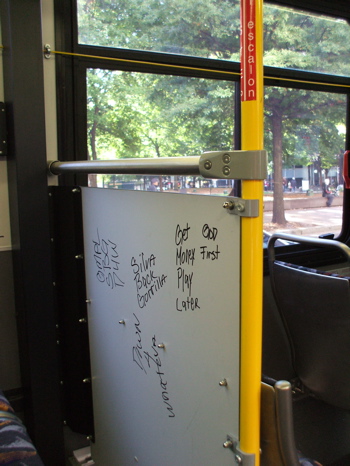
On the way to Civic Center station this morning, I made it across Peachtree at Ralph McGill/Ivan Allen just in time to board the Route 110 bus that was stopped at the intersection, heading south. On days when the timing is exactly right like that, it’s faster to ride the 110 from there to Five Points than to walk the rest of the way to Civic Center Station, wait for the train, (especially with the longer headways now) and get to Five Points that way. Instead of spending another ten minutes walking and waiting, I’m in motion toward the the destination during that time. Saving ten minutes might be of little consequence to most people, but for the chronically tardy like me, that’s serious business.

It was one of the new, black, partially stimulus-funded buses that started appearing this spring and frequently service the 110 route. I walked to the first seats past the the rear door, sat down, and encountered this:

Bus poetry, left side

Why?

I can almost (while strongly objecting) understand someone scrawling trite, usage-impaired verse on a bus that’s been in service for well over a decade and looks every day of it. But, these are only about six months old. Worse yet, I realized later that I’d seen these same substandard compositions when I got on the 110 at Buckhead Station some time during the summer. That means the bus was barely in service for three months (at most) before these underinspired wordsmiths got to it. Three months. MARTA keeps its stock for 12 years or 500,000 miles. Shouldn’t they at least get broken in before we give them the public restroom stall treatment?

And who are these people who walk around with a Sharpie, expressly for the purpose of vandalizing? Sharpies are to be used for good, not evil.

Found: Urban Omnibus

29 Oct

Something more substantive is in the oven, but for today, here’s one of the bounty of built-environment-oriented blogs I’ve happened upon in the last year or so.

Urban Omnibus, a project of the Architectural League of New York, is one of those places you can easily lose a couple of hours to without realizing it, even if you (like me) don’t live anywhere near NYC. It’s full of the kind of writing that shows you that the more you look at a city, the more you’ll realize that you haven’t seen.

The site isn’t just well-designed, it’s a media-rich, apparently bottomless well of news and analysis about the creation, usage and evolution of the city. A couple of my favorite posts so far:

Making Policy Public: Vendor Power!” explored the downright astonishing maze of regulations that New York’s more than 10,000 street vendors have to navigate in order to being heavily fined, along with the ways that a not-profit group recruited designers to help the vendors make sense of them.

Urban Topographies: Cuts & Patches is a look at one of the ways that history that can be observed right under your feet in urban areas.

Scene Cafe

25 Oct

Scene Cafe south viewAnyone know whether Scene Cafe is still on schedule for a partial opening in November?

What Now, Atlanta reported in mid-summer that the cafe portion of the cafe/lounge/office space would open next month. Next month starts in a week and I still can’t find a Web site for the place.

Scene Cafe southeast viewThese photos were taken during the last week of July and the place still looks more or less exactly like this on the outside. Could be that they’re waiting for some custom glazing for that C-shaped window on the east side. Scene Cafe east viewYou’d think the parking lot would have been paved by now, or that some painting might have been done, though.

That corner is in dire need of some life, so let’s hope the neighborhood didn’t scare the owner off already.

One step closer

10 Oct

The downtown Multi-Modal Passenger Terminal is inching a bit closer to becoming something we can use rather than something we keep hearing about.

The AJC reported Friday that Georgia DOT is scheduled to begin meeting with master developers interested in the project in just a few weeks. From Nov. 8 to Nov. 10 DOT representatives familiar with the legal, technical and financial aspects of the project will hold one-on-one meetings with leaders of development companies that are interested in submitting proposals, according to a late-September DOT press release.

I work in one of the buildings perched right over the gulch and walk right through there on my way from Five Points every (work)day. Far off though it still is, it’s going to make a huge difference to that part of downtown when that walk is through a someplace rather than a noplace.