Food Truck Wednesdays Downtown

10 Aug

This slideshow requires JavaScript.

If you’re a downtown worker or student wondering what all the food truck fuss is about, but you can’t fit truck tracking into your schedule,  Food Truck Wednesdays puts the food where you are.

The convoy of mobile meal vendors sets up Wednesdays on the Lower Alabama Street plaza at Underground Atlanta from 11 a.m. to 2 pm. This week’s group included Tamale Queen, Tex’s Tacos, Hail Caesar, King of Pops, Honeysuckle Gelato, The Fry Guy and Sweet Auburn Barbecue.

Idea of the Day: Desire Lines

27 Jul
Desire line between Lindbergh Station and Lindbergh Drive

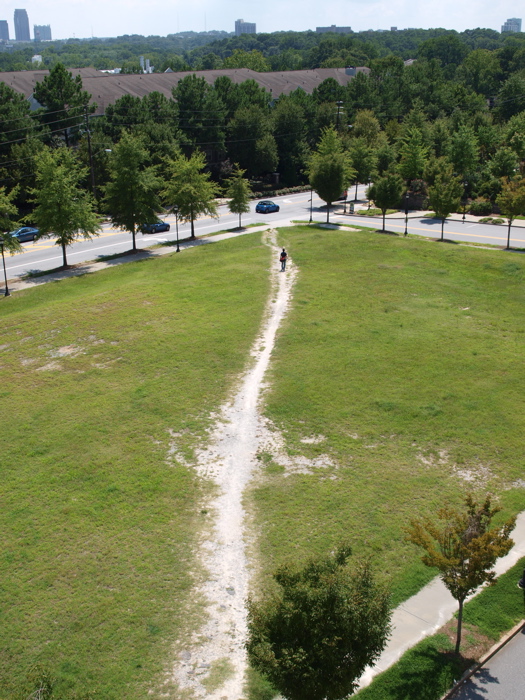
A five-year-old desire line cuts diagonally across the empty lot next to the Garson Drive parking deck at Lindbergh City Center

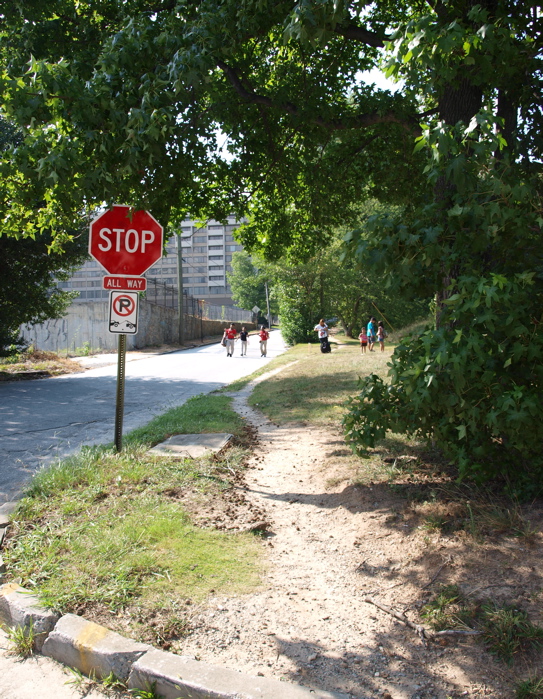
Desire Lines – also known as “intention lines, ” “paths of desire” or “desire paths” – are the paths worn into grass (or sometimes, snow) by pedestrians in places where sidewalks are unavailable or found to be inconvenient.

One of Atlanta’s most extensive collections of desire lines runs along both sides of Buford Highway, but college campuses, office parks and areas adjacent to transit stations are also prime locations for DIY pedestrian paths.

Pedestrian desire line on Oak Valley Road near Lenox Station

Pedestrians on the south end of Oak Valley Road, near Lenox Station, utilize the established desire lines or walk in the street where there's no sidewalk.

Monday Salmagundi

18 Jul
Contrary to the look of things lately, the OO has, in fact, not fallen off the face of the Earth.
Here:
  •  Mayor Reed has endorsed rescheduling next year’s vote on the regional transportation tax from the June Republican primary to the general election in November. Some of the tax’s proponents believe it could be a make-or-break change.

“We really have one opportunity to pass this referendum. If you check the data, higher voter turnout improves the chances of success,” Reed told the AJC. “In a referendum where your best election model gives you a 2 to 3 percent win, I believe that everything that you can do to add to that possibility you need to do.”

The State Legislature would have to approve the change, and Reed is expected to lobby for the change next month when lawmakers meet next month for negotiations on redistricting.

  • Finally, the Atlanta Business Chronicle reported that a building permit has been filed for a medical office development at 206 Edgewood Ave., right across from the Sweet Auburn Curb Market.

Elsewhere:

  • In The Geography of How We Get to Work, Richard Florida, writing for The Atlantic, examines the ways in which some less-than-obvious factors influence commuting choices.Using the results of statistical analyses of transit use, Florida found that old standbys like density and the number of available options are just part of the picture. A couple of points were especially relevant to Atlanta’s commuting patterns:

First, weather matters, but not in the way you might think. “People are more likely to drive to work where the weather is warm and/or wet,” Florida wrote. “Public transit use as well as walking and biking are more common in drier climes but also in places with colder January temperatures.”

Second, “The share of housing units built between 2000 and 2006 is negatively associated with the percentage of people who bike, walk or take public transit to work. Rapidly growing cities of sprawl – those which built the most houses during the height of the bubble – remain much more car-dependent than other places.”

  • From The Brookings Institution, City and Suburban Crime Trends in Metropolitan America – a report on how decreases in property and violent crime from 1990 to 2008 played out in the primary cities and suburbs of the country’s 100 largest metro areas. The analysis of FBI crime data and Census Bureau statistics found that, while about half of the metro areas saw declines in violent crime during the 12-year period, “cities were more likely to see violent crime fall than
    suburbs; more than half of the metro areas studied (56) experienced drops in city violent crime rates, while only 39 saw suburban violent crime decline.”

That difference, in turn, narrowed the gap between violent crime rates in cities and their suburbs: “Specifically, between 1990 and 2008, the violent crime rate in primary cities dropped from 2.8 times the comparable rate for the suburbs to double the
suburban rate, and the disparity in the average property crime rate dropped from twice the suburban rate to 1.7.”

  • Speaking of crime and going to work, Trulia Insights created a set of interactive charts depicting what times of day certain crimes are most likely to happen in 25 cities, based on crime stats from January 2011. Unlike in movies, criminals, like the rest of us, tend to do their jobs during the day. According to Trulia’s data, prime time for thefts is between 9 a.m and 7 p.m., when most people are away from home during the week. H/T to The Infrastructurist.
  • If you’ve never seen Vivian Maier’s urban photography, it’s probably because it spent most of the last 50 years as a welter of film canisters boxed up in storage. Maier, who died in 2009 at the age of 83, spent much of her working life as a nanny. But for decades she was also documenting city life on the streets of Chicago and New York. During that time she amassed a collection of about 100,000 photographs and negatives that almost no one ever saw.

In 2007 John Maloof purchased 30,000 of Maier’s negatives at a Chicago auction house, where the contents of her storage lockers were being sold after she fell behind on the payments.  Now, after reassembling about 90 percent of Maier’s collection of negatives, the rest of which had been sold to others at the same auction, Maloof  is cataloging and archiving Maier’s work and producing a documentary about her life and photography. (Originally posted at Polis back in February, but what’s a few months after five decades?)

Things You Never Knew You Wanted to Know: Taxi Facts

4 Jul

The Atlanta Police Department’s Bureau of Taxicabs and Vehicles for Hire enforces the city’s ordinances regarding taxi licensing and operation.

To operate a taxi in the city of Atlanta drivers must purchase of a Certificate of Public Necessity and Convenience, also sometimes referred to as a medallion. CPNCs can be purchased directly from the city or transferred from one operator to another.

Taxi drivers must be affiliated with a taxi company licensed by the City of Atlanta.

162: Chapter number of Atlanta’s municipal code governing the operation and licensing of taxis

23: The number of taxi companies licensed by the City of Atlanta

10: The maximum age at which vehicles may be used as a taxis in the city of Atlanta

1600: The number of CPNCs available for taxis in the city.

1554 to 1558: The number of CPNCs currently assigned

$6,000: The minimum cost to acquire a CPNC from the City of Atlanta.

$36,958.50: Average price paid for a City of Atlanta CPNC in 2010

$60,000: The highest price at which a CPNC was transferred from one operator to another in 2010*

$1: The lowest price for a City of Atlanta CPNC transfer in 2010

6: Number of months between inspections for each taxi

$2.50: Mandatory fare for the first one-eighth of a mile of a metered taxi trip. Each additional one-eighth of a mile is 25 cents.

$40.00: Flat rate fare between Buckhead and Hartsfield-Jackson International Airport

Sources:

  • Cedric Burse, manager of the Bureau of Taxicabs and Vehicles for Hire
  • Atlanta Municpal Code

*That sounds like a lot until you see the prices that New York City’s medallions go for. Average cost of a transfer between individuals there in 2010: $603,583.33

Light Up Atlanta: Five Points

1 Jul

This slideshow requires JavaScript.

Somehow, June is already over, so these are the last two photos from the Light Up Atlanta exhibition.

The two shown above are Shelly-Anne Tulia Scott’s “Pealing Back the Heart” and Ted Freeman’s “Hot-lanta Fan,” both at Five Points Station.

Transit tax might fall back to November

27 Jun

From Creative Loafing:

Georgia Department of Transportation Planning Director Todd Long told the Augusta Chronicle last week that the state is considering re-scheduling next year’s vote on the transportation tax from July to November.

If held in November, the tax would be on the ballot for the general election, whereas in July the vote would occur during the state’s Republican primary.

While voter turnout for the general election will be higher than for the Republican primary, the later date will also require an additional four months’ worth of privately-funded marketing expenses, Long said. There’s also the chance that, with more candidates and issues on a general election ballot, voters won’t give the transportation tax the attention and consideration that its backers hope for.

Telephone Town Hall Tonight

22 Jun

The Atlanta Regional Commission’s regional roundtable is holding a “Telephone Town Hall” meeting forFulton County residents at 6 p.m. today.

The meetings are a chance for residents to talk to the officials who make up the roundtable about what projects they want to see on the region’s transportation project list. The roundtable will work to finalize the project list over the next several months and the one percent sales tax to fund the projects will be put to a vote next year.

The number to call in for the meeting is 1-888-886-6603 and the PIN is 16727.

Light Up Atlanta: Lindbergh

19 Jun

This slideshow requires JavaScript.

Another piece from the “Light Up Atlanta” sculpture exhibition that’s on display at seven MARTA rail stations.

The artwork was produced by local architects and designers, and will remain through June 30.

TIA revenue estimates trimmed

17 Jun

Georgia’s fiscal economist announced this week that the Atlanta region should expect the Transportation Investment Act to generate less revenue than originally estimated for regional projects.

The one-percent sales tax that the TIA would put in place was previously expected to generate about $8 billion over the ten years for which it’s authorized, if voters approve it next year.

But Kenneth Heaghney, who prepared the estimates for the state, said that the calculations had to be adjusted to account for “a slightly worse outlook for the economy, as well as having time to do more exact work for this year’s projections,” the AJC reported.

The figure released this week was $8.5 billion – in 2011 dollars. Adjusted for inflation, the value is expected be reduced to about $7.2 billion. But only 85 percent of TIA-generated revenue will be available to spend on projects described as “regionally significant.”  The rest is allocated for local projects in the cities and counties in which it was raised. Shaving off that 15 percent leaves $6.14 billion for funding regional projects.

 Original and adjusted revenue estimates for all 12 Georgia regions are here (PDF).

This news means even more re-calibration and re-calculation for the Atlanta Regional Roundtable tasked with putting together a list of useful, affordable transit projects to go before the voters next year.

The “unconstrained list,” or “wish list” already far exceeds the original, more optimistic estimates that the one percent tax was expected to generate. The roundtable’s job is to reduce that list to one consisting of projects that the projected revenues can pay for. Now another $235 million worth of projects will have to be jettisoned.

But public officials have had to get used to getting more mileage out of less money lately.  Asked whether having less money to divvy up among projects would make the new tax a tougher sell, Norcross Mayor Bucky Johnson, who heads the roundtable for the Atlanta region told the AJC “I don’t think so. I mean it’s going to be hard enough,” and said, laughing “What’s a billion dollars among friends?”

Taxis and transit: Competitive or complementary?

15 Jun

Diving headlong into an unfamiliar transit system in a new city is some people’s idea of a good time. Boarding the wrong bus or getting off at the wrong station, perhaps ending up miles from the intended destination, are part of the fun of exploration for them.

But most people in the U.S. aren’t regular transit users and probably don’t share that particular sense of adventure. They prefer to get where they’re going with as little deviation and distress as possible.

Most of us have seen cars tentatively scooting down one of the city’s major arteries, hesitating at every intersection, turn signal going on, then off, back on, then off again, the occupants peering at street signs, trying to figure out whether this is the way back to the hotel and why there are no turning lanes.

Somewhere between braving strange streets in a rental car, and deciphering a bus schedule when you’ve never used one before, is the taxi. But are taxis part of public transit or part of car culture? Or both? Or neither?

Line of taxis on Baker street, downtown Atlanta

Taxis line up along Baker street in the early evening, waiting for customers from downtown hotels.

Drew Austin of Where, writing at The Urbanophile, says that taxis are not only part of public transit, they’re the only transit in places where other modes don’t reach. Their flexibility, Austin says, makes them a vital part of the transportation machine:

“It’s easy to forget, but the taxi has always been a critical form of public transportation. In cities without good transit, the taxi is often the only public transportation available. More importantly, mass transit cannot efficiently serve every type of travel that passengers demand, and the taxi is better suited to do so in many cases (think of the bus that never has more than a handful of passengers on board). Low-income city dwellers as well as the affluent rely on taxis where buses and trains don’t suffice. In the United States, where everything is seemingly built for the private car, modes of transportation that improve mobility for the carless are allies, not competitors.”

This topic came to mind yesterday when I had to use a taxi as a bridge between Five Points and Inman Park station after missing a Green Line train to Indian Creek. The next train would only go as far as King Memorial and it would be 15 minutes before service past there. The long headway plus the time to travel to Inman Park would have meant missing the route 6 bus at 12:40 that I needed to get to Emory.

Getting a cab was easy enough. But what it trip it was.

The driver first insisted that Decatur Street ends just past Grady hospital, then didn’t understand that I couldn’t go to just any MARTA station, so I couldn’t get out at King Memorial, which was the first one we passed.

He also gave the impression of not quite believing that there’s any such place as Inman Park Station. Even though I said that Inman Park is at least a mile past King Memorial, he slowed down every block, asking “Is it here?” or “Where is it?” Only after the GPS confirmed that such a place indeed exists was I able to go a full minute without saying “Please just keep going. It’s on this street, on the left. I’ve been there dozens of times.”

Although we did manage to make it to the station just before the 12:40 bus pulled into the bay, that’s one bridge I’m not looking to cross again any time soon.