Archive | Local RSS feed for this section

Public comment meeting on MMPT proposals is March 30

17 Mar

This slideshow requires JavaScript.

Although the Georgia Department of Transportation announced its choice for the development group for the MMPT project Monday, the agency has scheduled a public comment meeting on  March 30 from 4 to 7 p.m. at GDOT headquarters at North Avenue and W. Peachtree Street.

If you can’t make it to the meeting, contact GDOT about the project here.

H/T to Creative Loafing.

If you’d like to see the full presentation the slideshow images were chose from, it’s here [PDF].

Gulch redevelopment proposals: Summing up the summaries (Updated)

16 Mar

This slideshow requires JavaScript.

The three development teams short-listed to develop the multi-modal passenger terminal (MMPT) in the downtown “gulch” area have submitted their proposals to the Georgia Department of Transportation staff, the AJC reported Friday. The DOT posted summaries of the proposals in the MMPT section of their Web site.

The summaries are pretty short on details, but I pulled out a few highlights.

Continue reading

South Fulton County transportation survey for HB 277

15 Mar

Between e-readers and the availability used books for almost nothing online,  many of us don’t spend much time at public libraries any more. So, you could easily have missed the south Fulton County transportation survey that’s linked from the Atlanta-Fulton County Library home page. The survey’s purpose is to gather residents’ opinions on transportation project  priorities.  (Here’s a link to the PowerPoint presentation that the library’s site mentions.)

The “Transportation Investment Act of 2010,” also known as HB 277, requires each of the state’s 12 regions to vote next year on whether to assess themselves a 1 percent sales tax for 10 years to fund local and regional transportation projects. Residents will vote on the sales tax during the primary election in spring or summer of 2012. If the new tax is passed,  funds should become available for use in 2013.

Well, this ought to be interesting.

8 Dec

The new owners of the building now occupied by the men’s shelter at Peachtree and Pine are scheduled to have a hearing on their motion to evict the shelter from the space Thursday, according to the Midtown Ponce Security Alliance.

Thursday’s docket isn’t posted online at Fulton Superior Court’s site yet, but should be there Wednesday evening. As of right now, the hearing is scheduled for 2:30 p.m., Thursday, Dec. 9 in courtroom 5E, according to MPSA’s announcement.

Metro Atlanta Task Force for the Homeless appears to be carrying on as normal in the space, though, even opening a coffee shop on the Peachtree Street side of the building late last week.

Again, I’ll believe it when I see it. Evicting homeless people from a shelter in December is not going to play well politically. The shelter’s management isn’t likely to go quietly and  another NPR story won’t be far behind if the eviction goes forward. The wheels are turning, but it’s anyone’s guess how far they move right now.

Grand Plans, Iffy Execution

7 Dec

This slideshow requires JavaScript.

I made it to the afternoon sessions of the Grand Plans, Everyday Life symposium at Georgia Tech’s College of Architecture Saturday.

For someone completely unfamiliar with the Atlanta Beltline or who hasn’t been following its progress, it would have been a highly informative afternoon. Just about anyone else would have been contending with a raging case of Powerpoint fatigue and hoping to not hear the word “Beltline” again for a long time.

The streetcar projects, which are finally getting off the ground, warranted scarcely a mention the whole afternoon, perhaps because they’re municipal projects and the Beltline is more of a bottom-up undertaking. The streetcar is also lacking a  “face” like Ryan Gravel, who originally conceived the project, and evangelists like Angel Poventud. That’s not a complaint, just an observation.

Jennifer Clark moderates the panel discussion at Grand Plans, Everyday life. From left: Jennifer Clark, Fred Yalouris, Albert Churella, Angel Poventud, Ryan Gravel, Brian Leary

Albert Churella’s presentation – “Race, Railroads and Federalism” – just about made the trip worth it, though. Churella, who holds a doctorate in business history, is an assistant professor of social and international studies at Southern Polytechnic State University. He discussed (as thoroughly as one can in about 30 minutes) the effects of race, class and politics on transit planning in the Atlanta metro area, which is a topic that could easily be a day-long symposium of its own.

Maybe all the speakers were talked out by 6:15 p.m., when the time for the panel discussion rolled around. It was a bit lethargic, although it did briefly address concerns that the Beltline will be Atlanta’s version of a “Starbucks urbanism” project by and for upper middle-class people. That’s another topic that could easily warrant a long discussion on its own.

Strangely, the Q&A portion of the panel discussion was cut off after about three questions from the audience because of time constraints. Just from where I was sitting, I could see three more people with their hands raised to ask questions when the moderator said that they absolutely had to end. If you schedule an event in such a way that only allows for 10 minutes of questions from the people who sat there and listened all day, maybe your planning needs some work. But, the event was free, so I supposed one can only expect so much.

It was drizzling a little when I left, but I walked back to Midtown Station. It was a much quicker walk than I expected, and thanks to the many improvements to the campus and 5th Street, vastly more pleasant than it was eight years ago.

The trip to the campus is another story.  I’d planned to try the Tech Trolley, but the online weekend schedule simply says that it starts running from Midtown Station at 10:00 a.m. and runs “every 36 minutes.” Why 36? Couldn’t they just have it wait the extra four minutes to make the arrival time easier for riders to calculate? Or, better yet, actually list the times?

The long wait between Trolley runs put me off that idea, so instead I rode the #12 MARTA route for the first time. I caught the #110 about two blocks from my building, got off at Peachtree and 10th at 1:05, and scurried down to the station just barely – I thought – making it in time to catch the #12 that was scheduled to leave at 1:10. The bus was sitting there when I arrived and I got one of the few remaining seats. The driver, however, didn’t appear until at least 1:16. Is that normal?

Many’s the time I’ve sat on the #110 at Arts Center for several minutes past the scheduled departure time. I understand leaving late after arriving late, but what’s the reason for buses arriving at a station on time or early, then leaving several minutes late?

It seems like a little thing, but being kept waiting, for no reason that’s apparent, is something that riders really resent, especially those who don’t have another option to get where they’re going. It’s also one of the things that will keep choice riders off the buses forever. MARTA really can’t afford that.

France-Atlanta, Peachtree-Pine, and the Q

2 Dec

Sorry for falling off the face of the earth for so long. But, rather than bore you with the reasons, I’ll tell you about a few of the things that I should have been writing about the last couple of weeks:

  • According to the Midtown Ponce Security Alliance, the homeless men’s shelter at Peachtree and Pine won’t exist much longer in its current manifestation. MPSA doesn’t cite a source for the info, so it’s hard to tell how legitimate it is.  As with any change this big, I’ll believe it when I see it.
  • MARTA’s first BRT projects are up and running on Memorial Drive. Although they’re lacking dedicated lanes, the new “Q” route buses do have signal priority technology, queue-jump lanes at two intersections, and limited stops. I have absolutely nowhere to go on Memorial Drive, but I want to ride it just to see how quick the trip from one end of the route to the other is. Have you tried it?

Imperial, overstretched

10 Nov

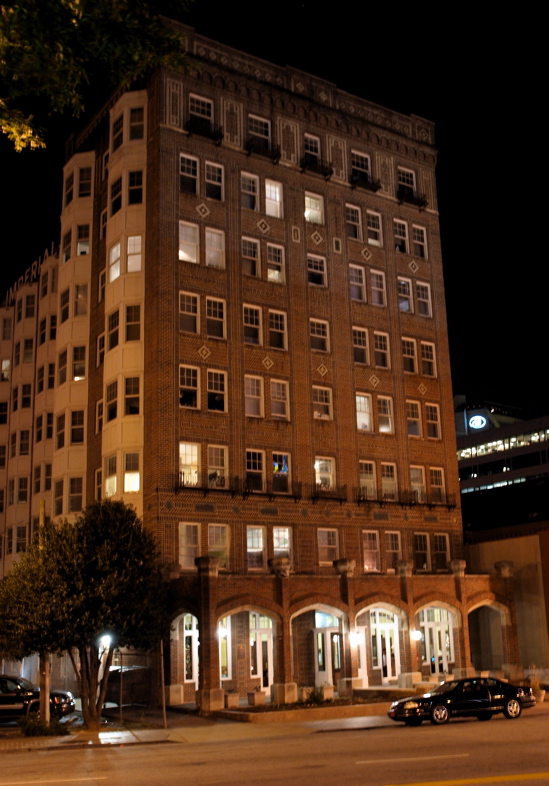
The development company that renovated the Imperial Hotel is in pretty dire straights, which could be very bad news for the people living there.

Imperial Hotel - Peachtree at Ivan Allen

According to Monday’s AJC, Progressive Redevelopment Inc. is in default on loans for six properties, the largest of which is the 120-unit apartment building at Peachtree and Ivan Allen. It’s scheduled to be sold at auction in January.

“Most of the money to rehabilitate the Imperial — about $8 million — came from low interest loans, tax credits and grants from Atlanta and the state. About $2 million is still owed to the city and the state, most of which will be lost in foreclosure.”

PRI specialized in developing residential properties for low-income residents and more than 1000 families stand to lose their homes because of the defaults, the AJC said.

“The company, ranked by the state as Georgia’s largest nonprofit developer, built or refurbished 38 projects with 4,000 apartments in 21 years, most in metro Atlanta.

PRI and a few partners owe more than $74 million and PRI is in default on at least 10 loans worth $8 million, including $5 million in government-backed loans.”

PRI already lost financial assistance from the state’s Department of Community Affairs earlier this year. DCA was the developer’s primary funding source.

It’s hard to decide whether to be concerned about the Imperial being sold. Is anyone really just itching to get his hands on a 99-year-old building that would require another renovation and an indeterminate number of years to draw profitable tenants?

It also seems unlikely that neither the state nor the city will step in before the worst happens. Allowing the low-income and formerly homeless residents of that building to be evicted would reflect badly on the state and would do nothing for Atlanta’s reputation as less-than-adept at addressing homelessness.

Finally, the Imperial sits just a block south of the Pine Street shelter, which was foreclosed on more than six months ago. Attorneys for that building’s new owner are still trying to wrestle it away from Metro Atlanta Task Force for the Homeless. The city is already defending itself against a lawsuit in which MATFH accused it of helping to orchestrate the foreclosure, so the mayor isn’t likely to want the city to be cast – again – as indifferent toward very poor people by allowing the Imperial’s residents to be put on the street.

But money to keep any of PRI’s properties afloat has to come from somewhere, and the bottom of the city’s and state’s budget barrels might have already been scraped. Measures that were unthinkable just a few years ago have had to be taken in plenty of other instances, so things could definitely go either way.